
Common Plant Myths Urban Gardeners Still Believe
Why do so many plants struggle in urban homes? This blog looks at common plant myths city gardeners still believe and why understanding context matters more than following universal rules.
3/15/20263 min read
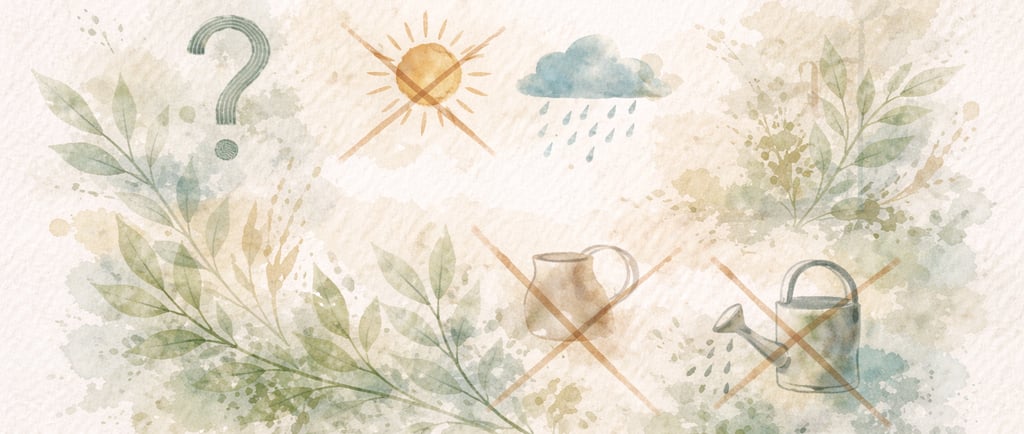
In cities, most of what we learn about plants comes casually—from social media reels, well-meaning friends, nursery conversations, or a single post that promises instant results. Over time, these bits of advice turn into rules. Rules that sound convincing, feel universal, and quietly shape how we garden.
The problem? Urban homes don’t follow universal rules.
Gardening in cities is shaped by compact spaces, unpredictable light, busy routines, and environments that change from home to home. When plant care is guided by myths instead of context, frustration often follows. Let’s gently unpack some of the most common plant myths urban gardeners still believe—and why they tend to stick around.
Myth 1: “All Indoor Plants Need Bright Sunlight”
This is one of the most widespread assumptions in urban gardening. Sunlight is often treated as a single, fixed requirement—something every plant needs in abundance.
In reality, light behaves very differently indoors. Windows filter sunlight, surrounding buildings block it, and the quality of light shifts throughout the day and across seasons. Many plants are perfectly adapted to softer, indirect light but struggle when placed in harsh conditions simply because they’re expected to ‘love the sun’.
The myth persists because sunlight feels like an obvious solution. When plants don’t thrive, we instinctively assume they need more of it—even when that isn’t the case.
Myth 2: “Watering More Means You Care More”
Watering is often seen as the primary act of care. When a plant looks tired or dull, the first response is usually to water it again.
But care isn’t measured by frequency. Overwatering is one of the most common reasons plants struggle in urban homes, especially indoors where airflow and evaporation are limited.
This myth persists because watering feels productive. It gives a sense of control and attention. Unfortunately, too much care—without observation—can do more harm than good.
Myth 3: “If a Plant Is Struggling, You’re Bad at Gardening”
Urban gardeners are often quick to blame themselves when a plant doesn’t thrive. There’s an unspoken belief that successful gardening is a personal skill you either have or don’t.
Plants, however, respond to change. Shifts in weather, light patterns, humidity, or even furniture placement can affect how they behave. A struggling plant isn’t a failure—it’s feedback.
This myth sticks because social media often shows only thriving, perfectly styled plants. The quiet, messy reality of plant care rarely makes it to the feed.
Myth 4: “You Need a Big Balcony or Garden to Grow Plants”
Space is often seen as the biggest barrier to gardening in cities. Small homes can make greenery feel like a luxury rather than a possibility.
Yet urban gardening has always been about adaptation. It’s not the size of the space that matters most, but how intentionally it’s used. A single well-considered plant can have more impact than a crowded collection squeezed into a corner.
This myth persists because we equate abundance with success—more pots, more plants, more growth—when simplicity often works better in urban settings.
Myth 5: “Plants Are Just Decorative”
Treating plants as décor is easy. They’re placed to fill gaps, match interiors, or soften corners. But plants are living elements—they grow, change, shed, and sometimes outgrow their spaces.
When greenery is chosen purely for appearance, frustration often follows when it behaves like a living thing instead of a static object.
This myth lingers because plants are sold visually. But living with them requires a shift in mindset—from decoration to relationship.
Unlearning Is Part of Urban Gardening
Most plant myths aren’t born out of carelessness—they come from oversimplification. In urban homes, where environments are layered and lifestyles are varied, simplified advice rarely holds up for long.
Letting go of these myths creates space for a more thoughtful, forgiving approach to gardening. One that values observation over rules, context over trends, and connection over perfection.
In the end, urban gardening isn’t about getting everything right. It’s about learning to listen—to your space, your routine, and the plants themselves.
Connect
Expert gardening help for urban spaces
Support
Legal
hello@theplantroom.co.in
+91 938 047 5876
© 2025. All rights reserved.